
Merging, Tombstones, and Shadowing
Merging, Tombstones, and Shadowing
Section titled “Merging, Tombstones, and Shadowing”Tombstones mark deletions at partition/row/cell levels (and ranges). This chapter explains how multiple SSTables and generations reconcile (shadowing), TTL expiry, and the effect of range tombstones.
In this chapter you will learn
Section titled “In this chapter you will learn”- Tombstone types and lifecycles
- Shadowing across SSTables/generations
- TTL expiry and gc_grace interactions
- Practical reconciliation rules
Read-Time vs Compaction-Time Reconciliation
Section titled “Read-Time vs Compaction-Time Reconciliation”Deletion and expiry are applied at two independent points, and confusing them is a common source of correctness bugs. Cassandra applies deletion/expiry visibility on every read, regardless of how many SSTables are involved; it applies garbage collection (physically dropping the tombstone) only during compaction.
Read-time visibility (applies even to a single SSTable)
Section titled “Read-time visibility (applies even to a single SSTable)”Reading one generation with no merge at all still requires three filters before a row reaches the client:
- TTL expiry. An expiring cell is live iff
nowInSec < localDeletionTime(Cell.isLive(long nowInSec),Cell.java); at or past that second it is invisible. - Partition deletion. The partition header’s
DeletionTimeshadows every row and cell whosetimestamp <= markedForDeleteAt—DeletionTime.deletes(long timestamp)is exactlytimestamp <= markedForDeleteAt()(DeletionTime.java:173–176), so the shadow is inclusive at equal timestamp. See Chapter 5 for the on-disk layout of this field. - Range tombstones. Range-tombstone markers shadow rows inside their clustering
interval, by the same
deletes(timestamp)rule.
In Cassandra this read-time filtering is a transformation applied over the (possibly
single-source) row iterator — Filter.applyToRow calls row.purge(..., nowInSec, ...)
and drops every range-tombstone marker before the client sees it
(Filter.java).
It is not part of the merge; a one-SSTable read gets it too.
CQLite implements read-time visibility at:
- Single generation —
PartitionShadow(cqlite-core/src/storage/sstable/reader/parsing/row_decoder/partition_shadow.rs:73open,:90feed_range_marker,:230cell_shadowed_or_expired), opened per partition by the row decoder (cqlite-core/src/storage/sstable/reader/parsing/row_decoder/block_emit.rs:105). It is deliberately not behind thewrite-supportfeature — read correctness must not depend on a write feature (issue #1741). - Multiple generations on the SELECT path —
ReadShadow, captured once per scan (cqlite-core/src/storage/sstable/generation_merge.rs:94, used at:265/:350), sharing the samecell_shadowed_or_expiredpredicate as the single-generation path (issue #1849). - Arrow Flight
do_get— the reconciliation clock is captured once per request and threaded into the merger (cqlite-flight/src/producer.rs:381now_secs, set at:472, passed at:569); without it, TTL expiry is a strict no-op (issue #2789).
Compaction-time reconciliation and purging
Section titled “Compaction-time reconciliation and purging”A compaction additionally performs cross-generation reconciliation (per-cell timestamp
compare and the equal-timestamp tie-breaks below) and then purges tombstones that
are past gcBefore and provably shadow nothing outside the compaction set — see
“gc_grace / gcBefore purging during compaction” below and Chapter 15.
TTL expiry inside CQLite’s merge is expire_ttl_cells
(cqlite-core/src/storage/write_engine/merge/reconcile.rs:468), which is a strict
no-op when the clock is absent (now_secs == None): a caller that does not supply a
reconciliation clock gets no expiry at all. Read paths must therefore always thread
their captured now.
Why this split matters for testing. A parity corpus built only from already- compacted SSTables has its tombstones purged on disk, so a read path that never applies read-time shadowing can still match a physical dump byte-for-byte. That is why CQLite keeps a query-semantics oracle (post-reconciliation
SELECTresults at a pinnednow) alongside the physicalsstabledumpgoldens — issue #1742. A physical-dump oracle enumerates every cell on disk including shadowed ones and cannot catch a read-time-reconciliation bug.
Tombstone Types
Section titled “Tombstone Types”- Partition, Row, Cell tombstones
- Range tombstones spanning clustering key intervals
Reconciling Multiple Generations
Section titled “Reconciling Multiple Generations”Reconciliation applies Cassandra 5.0 semantics to select visible values.
Row-level handling ensures newer data can supersede older row tombstones when timestamps allow.
Tombstone Tie-Breaking Hierarchy
Section titled “Tombstone Tie-Breaking Hierarchy”When two cells share equal timestamps, Cells.resolveRegular() applies this precedence
(Cells.java:79–128, CASSANDRA-14592):
- Tombstone/expiring beats live cell — any cell with a
localDeletionTimewins over a live cell at the same timestamp. - Pure tombstone beats expiring cell — a hard delete wins over a TTL-expiring write.
- Higher
localDeletionTimewins — between two expiring cells or two tombstones. - Lower TTL wins — between two expiring cells with equal
localDeletionTime. - Value bytes — final tiebreaker for live cells with identical timestamps.
CQLite reconciliation behavior and divergences
Section titled “CQLite reconciliation behavior and divergences”CQLite’s merge path (cqlite-core/src/storage/write_engine/merge/mod.rs:4188
reconcile_cluster) implements only PART of the equal-timestamp hierarchy above.
What it actually compares, per column, is narrow — and the divergences below are
not an exhaustive enumeration of every place it differs from Cassandra. These
are documented honestly here and tracked in Appendix F.
-
What
reconcile_clusteractually compares. Per(column, cell_path)(epic #921; multi-cell collection/UDT elements reconcile independently — see “Compaction merge semantics” below), the winner is chosen byreconcile_rules::cell_wins(cqlite-core/src/storage/write_engine/reconcile_rules.rs:70): (1) strictly highertimestampwins; (2) at equaltimestamp, a cell tombstone beats a live OR expiring cell (candidate.is_tombstone() && !existing.is_tombstone()), decided before anylocalDeletionTimecompare (issue #848, parity Cassandraa62c749); (3) otherwise the first-seen cell is kept — and because inputs arrive in heap-routing order (run_indexascending = newest file first), first-seen means the newer file. Row-tombstone shadowing then drops any surviving cell whosetimestamp <= row_del(the<=lets the row tombstone win at equal timestamp). That is the whole of the equal-timestamp logic. -
What matches Cassandra at equal timestamp. Because
is_tombstone()distinguishes a cell tombstone from any non-tombstone (whether live or TTL-expiring), CQLite’s check (2) makes a cell tombstone beat both a live cell and an expiring cell at equal timestamp — i.e. Cassandra’s rule 1 (tombstone beats live) and rule 2 (pure tombstone beats expiring cell) are both honored. (Verified: #822 finding #13/#3 HOLDS.) -
Equal-timestamp ordering BEYOND tombstone-vs-{live,expiring} — NOT implemented (further divergence). Cassandra’s
Cells.resolveRegularalso ranks non-tombstone cells: an expiring cell beats a pure-live cell (rule 1’s expiring half — anything with alocalDeletionTimewins over a plain live cell), higherlocalDeletionTimewins between two expiring cells or two tombstones (rule 3), and lower TTL wins between two equal-localDeletionTimeexpiring cells (rule 4).reconcile_clusterimplements none of these: at equal timestamp it treats an expiring cell as live, so expiring-vs-pure-live, two tombstones differing only inlocalDeletionTime, or two expiring cells differing only inlocalDeletionTime/TTL all resolve by first-seen instead of by Cassandra’s hierarchy. The mergeCellDatacarries nolocalDeletionTime, so these comparisons are not even representable today. These are additional (currently-unhandled) divergences — NOT parity. Authority:org.apache.cassandra.db.rows.Cells.resolveRegular. -
Live-cell value tie-break — CQLite divergence (#4/#21). When two live cells tie on timestamp (and neither is a tombstone), Cassandra’s
Cells.resolveRegularkeeps the cell with the strictly-greater RAW value bytes (unsigned lexicographic comparison on the raw value, skipping the VInt length prefix). CQLite currently keeps the first-seen cell (newer file) instead of comparing value bytes (reconcile_rules::cell_winsreturnstrueonly for a higher timestamp or an equal-timestamp cell tombstone). This is a known divergence (ruled a FIX in issue #818; the fix is a follow-up). Authority:org.apache.cassandra.db.rows.Cells.resolveRegular— its final statement isreturn compareValues(left, right) >= 0 ? left : right;, a raw-value compare through the type’sValueAccessor.This tie-break is a byte-level compare on the serialized value and is distinct from the typed ordering used for
ORDER BY,MIN/MAX,GROUP BYkeys, and clustering comparison. Forfloat/doublecolumns that typed ordering is Java’sFloat.compare/Double.comparecontract:FloatType/DoubleTypedelegate toNumberType.compareComposed, which compares the composedFloat/Doubleobjects (DoubleType.java,FloatType.java). That contract is a total order and differs from IEEE==/<in two ways:NaNsorts last (greater than+Infinity, and allNaNbit-patterns compare equal), and-0.0 < +0.0(the signed zeros are distinct and ordered). It is also not Rust’sf64::total_cmp, which places negativeNaNfirst. CQLite therefore implements the Java contract explicitly incqlite-core/src/float_cmp.rs(cassandra_double_cmp/cassandra_float_cmp) rather than reusingtotal_cmporpartial_cmp, and routes typed ordering through it — includingGROUP BYkey equality at every nesting depth (cqlite-core/src/query/select_executor/aggregation/group_key_cmp.rs:87, issue #2074) and clustering/collection ordering (cqlite-core/src/storage/write_engine/mutation.rs:832).One deliberate exception:
WHERE-clause (predicate) evaluation does not use the NaN-last total order. ANaNoperand yields SQL UNKNOWN and the row is dropped, because treatingNaNas the greatest value would maked > 1.5true ford = NaNand leak rows that an engine pushing the predicate down would discard; the same function compares two integral operands as exacti128first, since two distincti64above 2^53 collapse to onef64mantissa (cqlite-core/src/query/select_executor/value_ops.rs:136try_compare_values_predicate, issue #2231). Ordering and filtering therefore use intentionally different float rules; do not unify them. -
Complex (collection/UDT) column merge — per-cell-path (RESOLVED in epic #921). Cassandra merges complex columns per cell-path using the column’s path comparator — signed
ShortTypefor a UDT field index,TimeUUIDTypefor a list element, and the map key type for a map — applying shadow-before-purge per path. CQLite now reconciles complex columns per(column, cell_path):CellDatacarries acell_path, so disjoint elements of the same column survive and a same-key collision resolves by the higher per-cell timestamp (#844). UDT field paths are compared as signedShortTypeand complex columns are matched by name across differing source headers (#888/#927). Complex deletion markers reconcile with strict-supersede + shadow-before-purge (#887). See “Compaction merge semantics” below.
Compaction merge semantics
Section titled “Compaction merge semantics”Epic #921 brought CQLite’s compaction merge path
(cqlite-core/src/storage/write_engine/merge/mod.rs, reconcile_cluster, and the
merge_entry_to_mutation rewrite) substantially closer to Cassandra’s
CompactionIterator / Cells#reconcile. This section documents what the merge
actually does, verified against the code on this branch; each rule names the
function that implements it and (where given) the Cassandra parity commit.
Per-(column, cell_path) reconciliation (#844)
Section titled “Per-(column, cell_path) reconciliation (#844)”reconcile_cluster keys per-cell winners by (column, cell_path), not by whole
column. A simple cell has cell_path == None and behaves as before; each element
of a multi-cell collection or UDT carries its authoritative cell_path and
reconciles independently. Disjoint elements of the same column written in
different SSTables both survive; the same (column, cell_path) key resolves to
the cell with the higher per-cell timestamp (reconcile_rules::cell_wins). On the
write-out side, cells_to_cell_operations emits one
CellOperation::WriteComplexElement per surviving element (preserving its
cell_path, timestamp, ttl, local_deletion_time, and authoritative
is_deleted), so the elements round-trip rather than collapsing to a whole-column
value.
UDT cell-path ordering and match-by-name (#888 / #927)
Section titled “UDT cell-path ordering and match-by-name (#888 / #927)”A UDT field-index cell path is a 2-byte signed ShortType value, so a field
index in [32768, 65535] is negative as i16 and must sort before the
positive indices. compare_cell_paths(a, b, is_udt=true) decodes both paths with
i16::from_be_bytes and compares as signed; collection (non-UDT) paths keep
plain lexicographic byte ordering (parity Cassandra d14c96b8 / 5e636f9).
Complex columns are matched by name (ComplexDeletion.column,
udt_declared_field_names resolving a Value::Udt literal’s fields to their
declared index by name) rather than by header identity, so two sources whose
serialization headers differ still merge the same logical column. Non-frozen UDT
multi-cell data is now read and written end-to-end (#927).
Complex-deletion reconciliation (#887)
Section titled “Complex-deletion reconciliation (#887)”Complex (collection/UDT) deletion markers reconcile in a dedicated stage (Step 2b
of reconcile_cluster) that runs after per-cell winner resolution and
before the row-tombstone and gc_grace filters (parity Cassandra bd244649 +
f66fa14f):
- Strict supersede. Per complex column (matched by name) the active deletion
is the one with the greatest
marked_for_delete_at; a candidate supersedes only when itsmarked_for_delete_atis strictly greater — equal timestamps do not supersede. - Shadow before purge. For the surviving deletion on a column, every per-element
winner of that column whose timestamp is
<= marked_for_delete_atis shadowed (dropped) before the marker itself is purged, so a later purge of the marker can never resurrect a covered element. An element strictly newer thanmarked_for_delete_atsurvives.
Row-tombstone interaction. A row tombstone at row_del shadows only timestamps
<= row_del. In merge_entry_to_mutation, a carried complex-deletion marker whose
marked_for_delete_at is strictly greater than row_del covers a range the row
tombstone does not (including elements in SSTables outside this compaction), so it is
preserved and emitted as a CellOperation::ComplexDeletion alongside the
DeleteRow. A marker with marked_for_delete_at <= row_del is fully covered and is
dropped.
Tombstone-vs-expiring (TTL) tie-break (#848)
Section titled “Tombstone-vs-expiring (TTL) tie-break (#848)”At equal timestamp a cell tombstone beats an expiring (TTL) cell, and this is
decided before the localDeletionTime compare. reconcile_rules::cell_wins
compares timestamps first, then returns candidate.is_tombstone() && !existing.is_tombstone(); because is_tombstone() treats an expiring cell as
non-tombstone (it carries a real value plus a TTL, not a CellTombstone), the single
rule subsumes both tombstone-beats-live and tombstone-beats-expiring (parity Cassandra
a62c749). The further equal-timestamp ranking among non-tombstone cells
(expiring-beats-live, higher-localDeletionTime, lower-TTL) is still not
implemented — see the divergence note above and Appendix F.
gc_grace / gcBefore purging during compaction (#845)
Section titled “gc_grace / gcBefore purging during compaction (#845)”A tombstone whose on-disk localDeletionTime is strictly less than gcBefore is
purged from the output (Step 3c of reconcile_cluster, parity Cassandra 8d47ebb2).
Key invariants, verified in compute_gc_before and reconcile_cluster:
- Clock and cutoff.
localDeletionTimeis the GC clock in seconds;gcBefore = now_secs - gc_grace_seconds. When the table declares nogc_grace_seconds, CQLite falls back to Cassandra’s table default of 864000 seconds (10 days). An invalid (unparseable or negative) declared value returnsNone, disabling purging (a strict no-op — garbage metadata never drops data). - Unsigned LDT.
localDeletionTimeis read unsigned (i64::from(ldt as u32)) so a far-future LDT with bit 31 set is not mistaken for an ancient negativei32. LDT == 0is unknown. A zero LDT is the “not surfaced” placeholder and the tombstone is retained (never purge on unknown LDT — the no-heuristics mandate).- No resurrection. Purge runs after the complex-deletion shadow stage and the row-tombstone / dropped-column filters, so a now-redundant marker is dropped only once everything it covered within the compaction is already gone.
- Overlap safety. Purging happens only on an overlap-safe (full/major)
compaction that spans every SSTable for the table.
merge_partition_rowscollapses the effectivegc_before_secstoNonefor a partial/background compaction (KWayMerger::with_purge_safe/ thepurge_safeflag), so partial compactions retain tombstones and cannot resurrect data shadowed in a non-included overlapping SSTable. In the CLI this is opt-in via--major/--purge-tombstones.
Partition-granular vs row-granular merge
Section titled “Partition-granular vs row-granular merge”Cassandra merges lazily, one Unfiltered at a time. Partition-level merging is a
lazy iterator-of-iterators (UnfilteredPartitionIterators.merge), and within a
partition UnfilteredRowIterators.UnfilteredRowMergeIterator.computeNext() pulls a
single row or range-tombstone marker off the underlying MergeIterator and returns it
(UnfilteredRowIterators.java:523).
CompactionIterator delegates hasNext() straight to that iterator, so it does not
collect a partition’s reconciled rows before emitting the first one. Working memory is
bounded by the merge fan-out k (one buffered Unfiltered per source), not by the
partition’s width. This is what lets Cassandra compact a partition far larger than heap.
CQLite has two merge drivers over the same k-way heap, and which one a path uses determines its memory profile:
| Driver | Granularity | Where it runs |
|---|---|---|
KWayMerger::step() (merge/mod.rs:2981) | Whole partition — returns MergeStep::Partition { key, rows } with every reconciled row of one partition | multi-generation SELECT read path (storage/sstable/generation_merge.rs:268, :358, :464); Flight’s collect/aggregate paths |
StreamingMerger::step_streaming() (merge/streaming.rs:610) | One clustering-key group at a time, pulled directly off the heap | production compaction (merge::merge, merge/mod.rs:2728, driving StreamingMerger at :2773); resumable maintenance compaction (write_engine/maintenance.rs:738); Flight full-scan / point-read / cache-warm |
With the buffered driver, peak memory scales with the widest partition, independent
of k, of LIMIT, and of the output batch size — a LIMIT 1 against a multi-million-row
partition still materializes the whole partition first, and a cancellation flag is only
observed between partitions (issues #1668, #2230, #2423).
The streaming driver removes that whole-partition buffer: rows leave the merge as they
are reconciled, cancellation and byte budgets are honored mid-partition, and only a
bounded prefix is held. That prefix is not zero and the reason is a format property
worth knowing: a partition’s clustering_key: None carriers (the static row and the
partition/range-tombstone markers) always sort before any clustered row, and the writer
needs the partition’s complete range-tombstone set upfront to interleave markers with
rows in clustering order. A range tombstone’s coalesced marker is only surfaced once its
CLOSE bound is parsed, which — for a range whose covered rows live in a different
generation — can be after those rows have streamed past. The streaming compaction path
therefore buffers that bounded, partition-width-independent prefix and nothing else.
Flight’s row-granular entry point is drive_merge_over →
drive_merge_streaming (cqlite-flight/src/producer_stream.rs:71, :94), used by the
full scan (producer.rs:809), point reads (producer_point.rs:210), and cache warming
(producer_warm.rs:101, :120). The buffered drive_merge (producer.rs:941) remains
on the non-streaming collect path (merge_paths, producer.rs:916) — which returns a
fully materialized Vec<RecordBatch> anyway and serves as the parity oracle for the
streaming path — and on aggregation, whose output is bounded by the group count rather
than the row count.
Writer invariants surfaced by the merge path
Section titled “Writer invariants surfaced by the merge path”The compaction rewrite exposed several writer invariants that must hold or the delta-encoded SSTable would be corrupt:
- Stats/baseline must fold every emitted field. The Statistics.db baselines
(
min_timestamp,min_local_deletion_time,min_ttl) are folded overComplexDeletion(marked_for_delete_at+local_deletion_time),WriteComplexElement(per-elementtimestamp/ttl/local_deletion_time), and per-cellDelete(op_cell_local_deletion_time) inSSTableWriter::write_partition(writer/mod.rs). A marker or element whose timestamp/LDT lies below an un-folded baseline would underflow the unsigned delta. - Per-op deletion timestamp shadowing is uniform across the normal and shadowed writer paths.
- Per-cell
DeletelocalDeletionTime is preserved through the merge→writer path (cells_to_cell_operationsthreads the source cell tombstone’s own LDT intoCellOperation::Delete { local_deletion_time }), avoiding GC-clock drift that would purge a surviving tombstone too early — or keep it too long — in a later compaction. - The WAL has three backward-compatible record layouts (the WAL has no per-record
version field and bincode is positional): (A) pre-#764 (no mutation-level
local_deletion_time, oldDeleteop shape), (B) post-#764 / pre-#921 (mutation-level LDT present, oldDeleteop shape), and (C) current (CellOperation::Deletecarrieslocal_deletion_time).deserialize_mutationattempts most-recent-first and falls back, mapping older layouts toNoneLDTs.
Reference: Cassandra parity. Per-cell reconcile and the tombstone-vs-expiring tie-break mirror
org.apache.cassandra.db.rows.Cells#reconcile(commita62c749); complex-deletion strict-supersede + shadow-before-purge mirror commitsbd244649andf66fa14f; UDT signed-short paths + match-by-name mirrord14c96b8/5e636f9; gc_grace purging mirrors8d47ebb2.
Clustering order: empty vs valued under DESC
Section titled “Clustering order: empty vs valued under DESC”For a reversed (DESC) clustering column, an empty clustering value sorts
after a valued one; the empty-vs-valued comparison is routed through the
column’s reversed-ness rather than compared as raw bytes. CQLite implements this in
ClusteringKey::compare
(cqlite-core/src/storage/write_engine/mutation.rs): the per-column ordering from
compare_values (which orders an empty/Null value Less than a valued one) is
.reverse()d when ClusteringOrder::Desc, so under DESC the empty value compares
Greater (sorts last). This matches Cassandra’s reversed-type clustering
comparison.
Range Tombstones
Section titled “Range Tombstones”Range tombstones delete clustering intervals; readers must compare timestamps against range bounds during reconciliation.
Range tombstones are applied and emitted end-to-end through CQLite’s compaction
merge path (issue #933): the row decoder surfaces range markers to the merger
(cqlite-core/src/storage/sstable/reader/parsing/row_decoder/compaction.rs:504
on_range_marker), the merger coalesces open/close bounds into whole tombstones and
shadows the rows they cover (merge/mod.rs:3446 coalesce_range_tombstones, :3917
apply_range_shadowing), and a surviving range tombstone is re-serialized as
open/close bound markers in the output (writer/data_writer/cells.rs:333
write_range_bound). The end-to-end behavior is pinned by
cqlite-core/tests/issue_933_range_tombstone_compaction.rs.
A range tombstone’s coalesced marker is only known once its CLOSE bound is parsed, which can be strictly after the rows it covers have already streamed past (they may live in a different generation). That ordering property is why the streaming compaction path buffers a bounded, partition-width-independent carrier prefix — see “Partition-granular vs row-granular merge” above.
Tombstone Timeline Diagram
Section titled “Tombstone Timeline Diagram”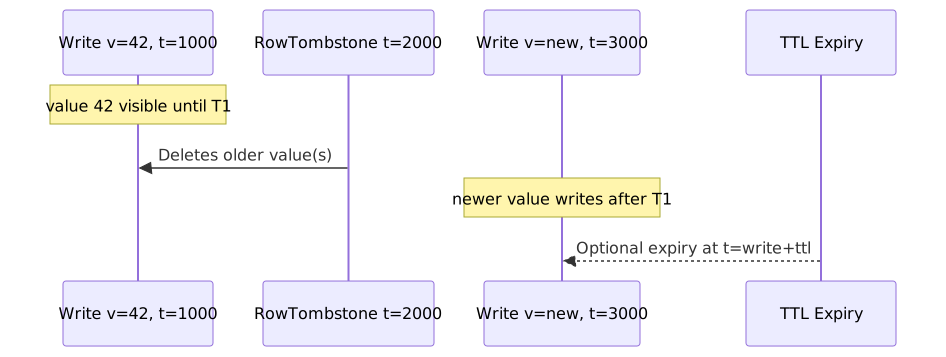
- Alt text: Timeline showing writes, tombstones, and TTL expiry with shadowing
- Caption: Newer values can shadow older tombstones; TTLs create time-bound deletions
Key Takeaways
Section titled “Key Takeaways”- Newest wins by timestamp; at equal timestamp, tombstones (and expiring cells) always beat
live cells (
Cells.java:94, CASSANDRA-14592). Within equal-timestamp tombstones: pure tombstone beats expiring cell; then higherlocalDeletionTime; then lower TTL. - Deletion/expiry visibility applies on every read, even from a single SSTable; tombstone collection happens only during compaction.
- Range tombstones apply only within their intervals and while active.
- TTL expiry can surface as synthetic tombstones.
- Cassandra merges rows lazily (bounded by fan-out k); a whole-partition-buffered merge driver bounds memory by the widest partition instead.
- Typed
float/doubleordering follows JavaDouble.compare(NaN last,-0.0 < +0.0), which is neither IEEE<nor Rust’stotal_cmp.
Complexity Notes
Section titled “Complexity Notes”- Merge per row: sorting values is O(k log k) where k is the number of versions; single-pass reconciliation after sort is O(k).
- Range tombstone filtering: O(n × t) worst-case (n entries, t tombstones) but typically reduced by time-sorted early exits.
References
Section titled “References”- Cassandra 5.0.8 (pinned):
Cells.java(tombstone reconciliation L79–L128) — https://github.com/apache/cassandra/blob/cassandra-5.0.8/src/java/org/apache/cassandra/db/rows/Cells.java#L79-L128DeletionTime.supersedes()(partition/row tombstone precedence L158–L161) — https://github.com/apache/cassandra/blob/cassandra-5.0.8/src/java/org/apache/cassandra/db/DeletionTime.java#L158-L161- Rows/tombstones package — https://github.com/apache/cassandra/tree/cassandra-5.0.8/src/java/org/apache/cassandra/db/rows
DeletionTime.deletes(long)(inclusive shadow at equal timestamp, L173–L176) — https://github.com/apache/cassandra/blob/cassandra-5.0.8/src/java/org/apache/cassandra/db/DeletionTime.java#L173-L176Cell.isLive(long nowInSec)(TTL expiry predicate) — https://github.com/apache/cassandra/blob/cassandra-5.0.8/src/java/org/apache/cassandra/db/rows/Cell.java#L173Filter(read-time purge/expiry transformation) — https://github.com/apache/cassandra/blob/cassandra-5.0.8/src/java/org/apache/cassandra/db/transform/Filter.javaUnfilteredRowIterators.UnfilteredRowMergeIterator.computeNext()(lazy row merge, L523) — https://github.com/apache/cassandra/blob/cassandra-5.0.8/src/java/org/apache/cassandra/db/rows/UnfilteredRowIterators.java#L523DoubleType/FloatType(Double.compareordering viaNumberType.compareComposed) — https://github.com/apache/cassandra/blob/cassandra-5.0.8/src/java/org/apache/cassandra/db/marshal/DoubleType.java
For implementation details, see Appendix C.